






The goal of all product descriptions is to sell the product, right? Well, the key to writing product descriptions is to interact with your potential customers on a personal level. Your product description is your opportunity to connect with them and get them to hit that “add to cart” button. How do you do that? By engaging with their feelings and emotions. In this article, we will give our ten best tips for writing product descriptions that do their job and sell products. We’ll even include some excellent product description examples!
How to Write Product Descriptions
- 1 How to Write Product Descriptions
- 2 Tips for Writing Product Descriptions
- 2.1 Make Sure it’s Informative
- 2.2 Keep it Clear and to the Point
- 2.3 Focus on Experiences
- 2.4 Don’t Forget SEO
- 2.5 Utilize Headers and Bullet Points
- 2.6 Stay True to Your Branding
- 2.7 Write Benefit-Oriented Product Descriptions
- 2.8 Create Mobile-Friendly E-Commerce Product Descriptions
- 2.9 Create Image-Rich Product Pages
- 2.10 Write for Your Audience
- 3 Tips for How to Write Product Descriptions
- 4 Get Help with Product Description Writing Services
- 5 FAQ: Writing Product Descriptions That Sell
- 5.1 What is a product description and what should it include?
- 5.2 How long should a product description be?
- 5.3 How do I make my product descriptions more engaging?
- 5.4 Do I need to worry about SEO in product descriptions?
- 5.5 How can I make my product descriptions mobile-friendly?
- 5.6 Should I use the same tone for all my product descriptions?
- 5.7 What’s the difference between features and benefits in product descriptions?
- 5.8 How important are images in product descriptions?
A product description is the marketing copy in your online store that explains what the product is and why it is worth buying. The purpose of a product description is to give customers all the important and relevant details about the product. However, there is one common mistake when it comes to writing product descriptions: simply describing the product and leaving it at that. Why is that a mistake? Because your product description needs to do more than that.
How will it help your customer solve a problem, or make their life easier? Answer that question, and you are on your way to a solid product description. Great product descriptions not only describe what the product is, but they also sell the product.
A great product description not only entices the reader into buying your product, but also lures them to the product in the first place from the search results.
Tips for Writing Product Descriptions
Here are our 10 best tips for writing effective product descriptions for your ecommerce site:
Make Sure it’s Informative
The main reason people are on your product pages is to learn more about the product itself. What questions might a person have about your product? Make sure you answer any potential questions they might have. The best product descriptions include who, what, why, and how. Every product description should answer the following questions:
- What is this product?
- Who is this product designed for?
- Why does the customer need it?
- How is it used?
While you want to tell your customer about the product, don’t forget to include any necessary sizes, specifications, etc. that the customer might need to know. If they can’t find that pertinent information, they might just leave your product page and not return. Include all of the features and benefits of your product!
Keep it Clear and to the Point
While you do want to include all the necessary information for your reader, it’s also important not to go on too long. Your product description should be clear and to the point. Let’s be honest: no one is going to read several paragraphs about a t-shirt. If you try to cram too much text into your product description, you will lose your reader. We recommend limiting yourself to two to three sentences in one paragraph about the item, if possible. Simply use power words and phrases to describe your product.
If you do need to include a lot more information, rather than add an additional paragraph, instead use bullet points or tabs to make it more visually appealing.
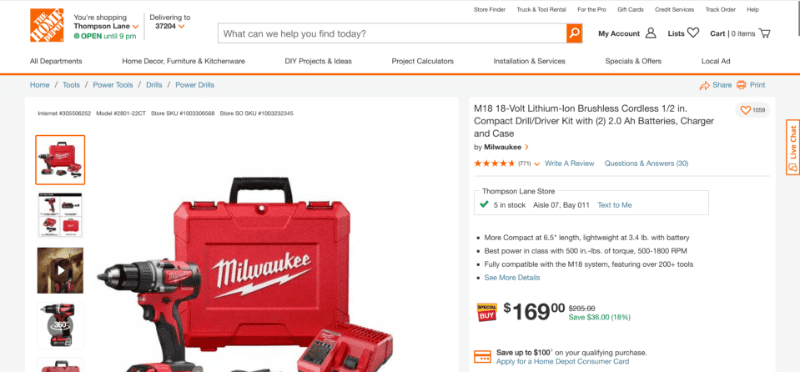
For example, Home Depot describes this Milwaukee drill with all of the exact specifications someone shopping for a drill might need to know, and focuses less on a lengthy description of the product itself.
Focus on Experiences
Another way to engage your reader with your product is to get them involved. How do you do that? By telling your customer about the experience they will get with your product. How will it make them feel? (Obviously, this tip works better for some products than others.)
Rather than just a boring checklist of what is included with the product, focus on what your customer can expect to experience with your product. Feel free to tell a story in your product description. These days, people purchase products that they feel match their lifestyle. Describe the ideal lifestyle for your target audience, and you will likely have a new customer.
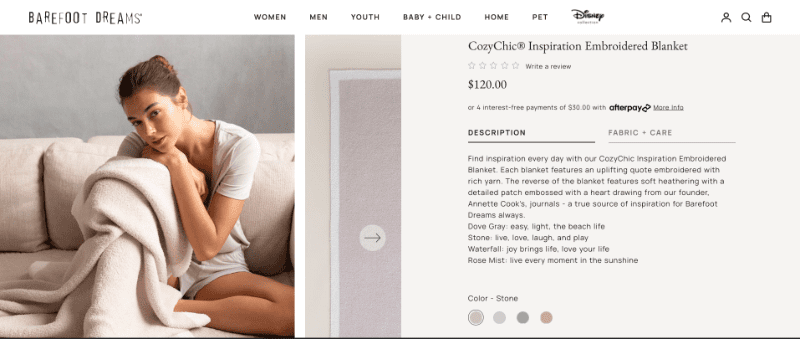
For example, Barefoot Dreams markets their blankets by telling you which color throw will bring which vibes to your life. For the “Waterfall” color, they say, “joy brings life, love your life.”
Don’t Forget SEO
Yes, the rules of search engine optimization still apply in product descriptions. You don’t just want to impress customers who are on your page. You also need to draw them there in the first place! But how do you do that? By utilizing keywords. This makes sure that your products appear in front of the people who are searching for them on Google and other search engines.
While it’s true that high-quality product copy will do its part to help your search ranking, it is still important to include keywords, title tags, alt text in images, and meta descriptions. Product descriptions are a great place to use long-tail keywords, too. These are keywords that are more like a keyphrase. They are longer and more specific than a traditional keyword. Utilizing these kinds of keywords ensures that people who are searching for exactly your item find it. Just be sure to use your keywords in your content as naturally as possible.
Utilize Headers and Bullet Points
The way your product description looks is just as important as the text itself. No one looks at a big block of text and wants to read the whole thing, particularly while they’re shopping online. Rather than just writing chunks of texts, use bullet points and white space to highlight the most important features of your product. You can also use headers to break up the text and make it easier for readers to scan quickly and find the information they are looking for. (Plus, headers help boost your SEO, too!)
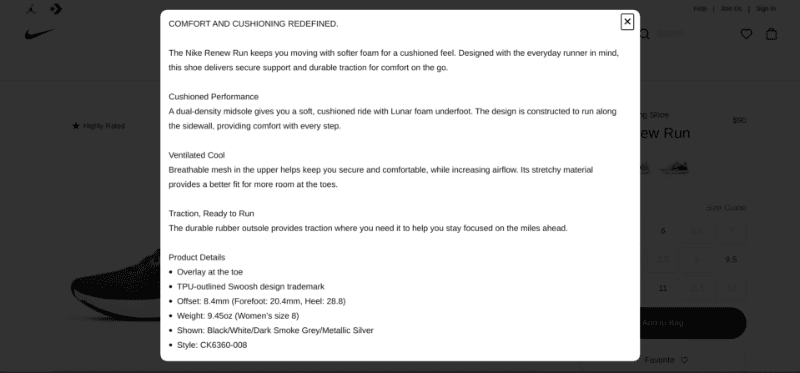
One brand that excels at this particular kind of product writing is Nike. Check out how they used headers and bullet points in this description of a pair of running shoes:
Stay True to Your Branding
Your product descriptions are an extension of your online content, which means your branding and voice need to remain consistent. Each of your product descriptions needs to stay true to your brand message. Your online brand is what creates brand loyalty.
It’s not always about simply the product you are selling, but how you are branding said product. For example, two companies can sell the exact same product, but market that product completely differently.
Write Benefit-Oriented Product Descriptions
What are the benefits of your product? One of the most effective ways to convince someone to buy your product is to show them how your product can directly enhance their life. Rather than simply list the details about your product, tell your potential customer how that feature can help them.
Perhaps you are selling running shoes. A basic product description might list the colors and sizes available and describe the shoe’s materials. However, a better product description would say something like, “This shoe provides the best comfort for serious runners training for their next marathon.” Now, experienced runners will know that this is the right shoe for them.
Create Mobile-Friendly E-Commerce Product Descriptions
These days, more people are shopping on their smartphones rather than their desktop computers than ever before. That’s why your product descriptions need to be mobile-friendly. Yes, need. Mobile compatibility is more important than ever for ecommerce websites. If you want as many customers as possible, you need to make sure that your product descriptions look good on all kinds of screens: tables, smartphones, laptops, desktop computers and even smart TVs.
Keep in mind that smartphone screens are smaller and oriented vertically. The layout of your content is critical for mobile optimization. This is where bullet points come in handy.
On mobile, we recommend that your product description simply includes an image, the name of the product, a short, descriptive sentence, and perhaps the average amount of stars given to the product. (Reviews are an excellent form of social proof and can definitely contribute to the purchase decision.) Most importantly, you should include an “add to cart” button that shoppers can easily tap to purchase.
Create Image-Rich Product Pages
Don’t be afraid to utilize more images than text on your product pages, if visuals are more effective for selling your product. Visuals are more engaging than text for most people, anyway. Just make sure that the images you choose are extremely high-quality, professional photos, and that they are engaging and persuasive.
Frequently, you will see this tactic used for vehicles. A photo of a Jeep driving through a jungle is much more exciting than a block of text listing all the car’s features. (Though, that should be included too! However, you can hide it behind a tab where an interested user will click to read it.)
For example, take a look at this product page from Jeep’s website. It simply shows photos of all their available vehicles, the name of the model, and the price. Simple, yet probably effective.

Write for Your Audience
Just like any other kind of writing, the most important part of product description writing is to write directly to your target audience. Whoever your audience is, from new parents, college students, Gen Zers, or millennials, just make sure you know who they are, what they want, and how your product can satisfy and need or desire they have. What are their pain points? Address them. Feel free to get creative! There is no such thing as a perfect product description template.
Tips for How to Write Product Descriptions
Here are some simple tips to keep in mind when writing your product descriptions:
- Keep it simple yet descriptive
- Use headers and bullet points
- Choose expressive words
- Appeal to your audience’s feelings
- Utilize e-commerce SEO best practices, like keywords
- Tell your reader how your product will help or benefit them
- Include specifics about your product
- Write simple sentences that anyone can understand
- Answer any questions potential customers might have about your product

Get Help with Product Description Writing Services
If you would prefer to hire a product description writer to help you, we are available. SEO Design Chicago has experience designing and writing product pages and product descriptions for ecommerce websites. Contact us today for help with your product descriptions!
FAQ: Writing Product Descriptions That Sell
What is a product description and what should it include?
A product description is marketing copy in your online store that explains what a product is and why customers should buy it. An effective product description should answer four key questions: What is this product? Who is it designed for? Why does the customer need it? How is it used? It should also include essential details like sizes, specifications, features, and benefits while focusing on how the product solves problems or improves the customer’s life.
How long should a product description be?
Keep your product descriptions clear and concise—ideally two to three sentences in one paragraph. Remember, shoppers won’t read several paragraphs about a single item. If you need to include more detailed information like specifications or technical details, use bullet points, headers, or tabs to make it visually appealing and easy to scan rather than adding lengthy paragraphs.
How do I make my product descriptions more engaging?
Focus on experiences rather than just listing features. Tell customers how your product will make them feel and what lifestyle it supports. Use storytelling to help shoppers envision themselves using your product. Write benefit-oriented descriptions that show how features directly enhance their lives. For example, instead of just listing shoe materials, explain how “this shoe provides the best comfort for serious runners training for their next marathon.”
Do I need to worry about SEO in product descriptions?
Yes! SEO is crucial for product descriptions because it helps potential customers find your products through search engines. Include relevant keywords naturally throughout your description, and use long-tail keywords (longer, more specific phrases) to reach shoppers searching for exactly what you offer. Don’t forget to optimize title tags, alt text for images, and meta descriptions to improve your search rankings.
How can I make my product descriptions mobile-friendly?
Since more people shop on smartphones than ever before, mobile optimization is essential. Keep descriptions short and use bullet points for easy scanning on smaller screens. On mobile, include an image, product name, a brief descriptive sentence, customer ratings, and a prominent “add to cart” button. Ensure your layout works well on vertically-oriented smartphone screens and test across different devices.
Should I use the same tone for all my product descriptions?
Your product descriptions should always stay true to your brand voice and remain consistent across all products. Your branding creates customer loyalty and trust. While the tone should be consistent, remember to write directly for your target audience—whether they’re new parents, college students, Gen Zers, or millennials. Understanding who they are and what they want is key to creating descriptions that resonate.
What’s the difference between features and benefits in product descriptions?
Features are what your product has or does (materials, specifications, functions), while benefits explain how those features improve the customer’s life. Instead of simply listing features, focus on benefits by showing customers how each feature helps them. This approach is more persuasive because it helps shoppers understand the real value your product provides and why they specifically need it.
How important are images in product descriptions?
Images are extremely important and can be even more engaging than text for most shoppers. Use high-quality, professional photos that are persuasive and help customers visualize the product experience. Create image-rich product pages that show the product in action or in context. For example, showing a Jeep driving through a jungle is more compelling than just listing features. You can always include detailed specifications in tabs for interested customers to access.

Contact Us today!