






As SEO Design Chicago’s team has worked with hundreds of businesses across different industries and verticals over the past decade, we’ve witnessed firsthand how multi-location SEO has evolved from a simple directory listing strategy to a sophisticated digital marketing discipline. The businesses that dominate local search in 2026 aren’t the ones with the biggest budgets—they’re the ones with the smartest systems.
After analyzing performance data from our multi-location clients and conducting extensive research into what separates successful multi-location strategies from those that struggle, we’ve identified the tactics that actually move the needle. This isn’t theory—it’s what works in the real world for businesses managing anywhere from 3 to 300 locations.
The Multi-Location Challenge: Why Most Businesses Struggle
- 1 The Multi-Location Challenge: Why Most Businesses Struggle
- 2 Location Pages: Your Foundation for Multi-Location Success
- 3 Google Business Profile Optimization: The Local Visibility Multiplier
- 4 Local Link Building: Quality Over Quantity in Your Own Backyard
- 5 The Systems That Separate Winners from Losers
- 6 Measuring Success: The Metrics That Actually Matter
- 7 Common Pitfalls and How to Avoid Them
- 8 The Technology Stack for Multi-Location Success
- 9 Real Results: What Success Looks Like
- 10 Looking Ahead: Multi-Location SEO in 2026 and Beyond
- 11 Partner with Experts Who Understand Multi-Location Complexity
Managing local SEO for a single location is straightforward. You optimize your Google Business Profile, build some local citations, create location-specific content, and monitor your rankings. But when you’re responsible for 10, 50, or 100 locations, everything changes.
The challenges compound exponentially. Each location needs its own unique presence, yet maintaining brand consistency across all locations remains critical. A single mistake in business information—say, an outdated phone number—can propagate across dozens of directories, confusing customers and damaging search rankings. Without proper systems in place, even basic tasks like responding to reviews become overwhelming.
According to recent industry research, 96% of consumers discover local businesses through online searches, but only 9% scroll past the first page of results. For multi-location businesses, this means each individual location must fight for visibility in its local market—and most are losing that battle.
What we’ve learned through our work with multi-location clients is that success requires three things: systems that scale, data that stays accurate, and content that feels local without being duplicative. Let’s break down exactly how to achieve this.
Location Pages: Your Foundation for Multi-Location Success

Every multi-location SEO strategy begins with location-specific landing pages. These pages serve as the home base for each location on your website, providing both search engines and customers with clear signals about where you operate and what you offer.
The biggest mistake we see businesses make? Creating cookie-cutter location pages that differ only by city name. Google’s algorithms have become remarkably sophisticated at detecting thin, duplicative content. A location page that simply swaps “Chicago” for “Dallas” while keeping everything else identical won’t rank—and it won’t convert.
The Anatomy of a High-Performing Location Page
Based on our analysis of top-performing location pages across our client base, successful pages include these essential elements:
Unique, Substantive Content: Each location page should contain at least 500-800 words of original content. This doesn’t mean fluff—it means genuine information about the specific location, the team members who work there, the services offered at that branch, and local area information that matters to customers.
Proper URL Structure: The URL architecture you choose matters significantly. We typically recommend subdirectory structures (yoursite.com/locations/chicago/) over subdomains, as they consolidate authority to your main domain while still providing clear geographic signals.
Local Schema Markup: Implementing LocalBusiness schema on every location page tells search engines exactly what type of business you operate, where it’s located, your hours, and how customers can contact you. This structured data has become increasingly important as search engines rely more heavily on machine-readable signals.
Embedded Maps and Driving Directions: While it might seem basic, embedding a Google Map showing your exact location helps both users and search engines. Include written directions from major highways or landmarks that locals would recognize.
Location-Specific Reviews: Showcasing customer reviews specific to each location builds credibility and provides fresh, user-generated content that search engines value.
Local Images: Use actual photos from each location—the storefront, the team, the local area. Stock photos undermine authenticity, and search engines can increasingly detect them. We’ve seen locations rank significantly higher after replacing generic imagery with location-authentic photography from our professional photography services.
Creating Unique Content at Scale
The question we hear most frequently: “How do we create unique content for 100 locations without it taking forever?”
The answer lies in templated frameworks filled with location-specific variables. Start with a content template that includes sections like team bios, local service areas, community involvement, and location history. Then, gather unique information for each location to populate these sections.
For a plumbing company with 50 locations, this might mean interviewing the local manager about the most common service calls in their area, photographing their team, and writing about local regulations or water quality issues specific to that region. Yes, it requires effort upfront—but it’s the difference between pages that rank and pages that don’t.
Google Business Profile Optimization: The Local Visibility Multiplier

If location pages are your foundation, Google Business Profiles are your growth accelerator. When someone searches “restaurants near me” or “plumber in Dallas,” Google prioritizes businesses with complete, optimized, and actively managed profiles.
The challenge for multi-location businesses? Each location needs its own individual profile, and managing dozens or hundreds of profiles manually becomes impossible. Yet businesses that master Google Business Profile optimization at scale see dramatic increases in local visibility.
The Non-Negotiable Elements of Profile Optimization
Category Selection: Your primary category is the single most important ranking factor for local search. According to recent local SEO studies, selecting the right primary category can influence up to 30% of your ranking power. Choose the category that most precisely describes your core business—not the one you think has less competition.
NAP Consistency: Your business Name, Address, and Phone number must be identical across your Google Business Profile, website, and every directory listing on the internet. Even minor variations—like “Street” versus “St.”—can confuse search engines and weaken your local signals.
Complete Business Information: Fill out every field Google provides. Business hours, service areas, attributes (like “wheelchair accessible” or “free WiFi”), website links, appointment URLs—everything. Profiles with 100% completion consistently outrank those with missing information.
High-Quality Visual Content: Google explicitly states that businesses with photos receive 42% more requests for driving directions and 35% more click-throughs to their websites. For multi-location businesses, this means each location needs its own unique photo collection—ideally updated quarterly.
Regular Posts: Google Business Profile posts may not directly impact rankings, but they signal to Google that your business is active and engaged. Our research shows that locations posting at least twice per month maintain better visibility than those that don’t.
Managing Multiple Profiles Without Losing Your Mind
Here’s the reality: you cannot manually manage 50+ Google Business Profiles effectively. The businesses succeeding at multi-location SEO use centralized management systems that allow bulk updates while still permitting location-specific customization.
We’ve developed internal systems for our multi-location clients that include:
- Centralized dashboards showing the health status of every location profile
- Automated alerts when profiles are edited or suspended
- Templated post schedules with location-specific variables
- Review monitoring and response workflows
- Photo upload queues organized by location and date
The key is finding the balance between maintaining brand consistency across all locations while allowing enough flexibility for each location to feel authentic to its local market.
Local Link Building: Quality Over Quantity in Your Own Backyard

If someone tells you that local links don’t matter in 2026, they’re wrong. What has changed is how search engines evaluate the quality and relevance of those links. The old playbook of submitting to hundreds of generic directories is dead. The new approach focuses on earning genuine, contextually relevant links from authoritative local sources.
Our analysis of top-ranking multi-location businesses reveals a consistent pattern: they’ve built strong local link profiles for each major location, with links coming from sources that make logical sense for a business operating in that area.
Scalable Local Link Building Tactics That Actually Work
Local Business Directories: Yes, basic directories still matter—but only the right ones. Focus on high-authority directories like Yelp, YellowPages, and industry-specific directories (like Avvo for lawyers or Healthgrades for doctors). According to recent link building research, approximately 125 high-quality local links from trusted sources provide substantial ranking benefits.
Local Media and Press: Getting featured in local newspapers, news sites, or community blogs provides powerful local signals. The catch? You need an actual story worth covering. We’ve helped clients earn local press through community involvement, local hiring initiatives, charitable partnerships, and expert commentary on local issues.
Chamber of Commerce and Business Associations: Nearly every city has a Chamber of Commerce, and membership typically includes a directory listing with a link. While this alone won’t catapult you to the top of rankings, it’s a legitimate, relevant local signal that adds up across dozens of locations.
Local Sponsorships: Sponsoring local sports teams, community events, or charitable causes often results in links from event websites, local news coverage, and community organization pages. A multi-location business sponsoring Little League teams in each community it serves can build dozens of authentic local links.
Local Partnerships: Forming strategic partnerships with complementary local businesses creates natural link opportunities. A multi-location tire shop might partner with local car dealerships, auto body shops, or oil change services—with each business linking to the others as trusted partners.
Avoiding the Local Link Building Pitfalls
The biggest mistake multi-location businesses make with link building? Thinking nationally when they should think locally. A link from a national industry publication is valuable, but for local search visibility, a link from a highly-trafficked local blog or news site often carries more weight.
We’ve also seen businesses damage their SEO by purchasing links from link farms disguised as “local business networks.” Google has become remarkably adept at identifying and devaluing these artificial link schemes. The penalties for getting caught can devastate your local visibility across all locations.
Our approach with link building services? Build relationships, not just links. Focus on earning links through genuine business activities, partnerships, and community involvement. It’s slower than buying links, but it’s sustainable and it works.
The Systems That Separate Winners from Losers
After working with dozens of multi-location businesses, we’ve identified a clear pattern: the companies dominating local search aren’t necessarily the ones with the best individual tactics—they’re the ones with the best systems.
Successful multi-location SEO requires treating your digital presence like an operational system, not a marketing project. This means establishing protocols, automating repeatable tasks, and maintaining rigorous data quality standards.
The Central Source of Truth
Every multi-location business needs a single, authoritative database containing accurate information for every location. This isn’t your website or your Google Business Profile—it’s a separate master database that feeds information to all other platforms.
This database should include for each location:
- Official business name (exactly as it should appear everywhere)
- Complete address with standardized formatting
- Primary phone number and any alternate numbers
- Hours of operation, including holiday hours
- Services or products offered at this location
- Key staff members and their contact information
- Google Business Profile URL
- Website location page URL
- Social media profiles specific to this location
When information changes—a phone number update, new hours, a staff change—you update it in one place, and that change propagates to all other platforms. Without this central database, inconsistencies proliferate and your local search visibility suffers.
The Review Management System
Online reviews directly impact local search rankings, with both the quantity and recency of reviews serving as ranking factors. More importantly, 88% of consumers trust online reviews as much as personal recommendations.
For a business with dozens of locations, manually monitoring and responding to reviews becomes impossible. You need systems that:
- Aggregate reviews from all platforms (Google, Yelp, Facebook, industry-specific sites) into a single dashboard
- Alert the appropriate manager when a new review is posted at their location
- Provide templated responses that maintain brand voice while allowing personalization
- Track response rates and average response times by location
- Flag negative reviews that require immediate attention
We’ve implemented review management workflows for clients through our reputation management services that ensure every review receives a response within 24 hours—even for businesses with 100+ locations generating hundreds of reviews monthly.
The Content Production Machine
Search engines reward websites that regularly publish fresh, relevant content. For multi-location businesses, this creates both a challenge and an opportunity.
The most successful multi-location content strategies we’ve implemented follow a hub-and-spoke model:
- The corporate blog publishes industry-wide content, company news, and thought leadership
- Regional blogs (if you have multiple locations in distinct regions) publish content relevant to that geographic area
- Location pages receive quarterly updates with local news, seasonal services, or staff spotlights
- Google Business Profile posts go out weekly with location-specific offers, events, or updates
This requires a content calendar, defined responsibilities, and often a team of writers. Our content writing services have helped multi-location clients maintain consistent, high-quality content production across dozens of locations without overwhelming their internal teams.
Measuring Success: The Metrics That Actually Matter
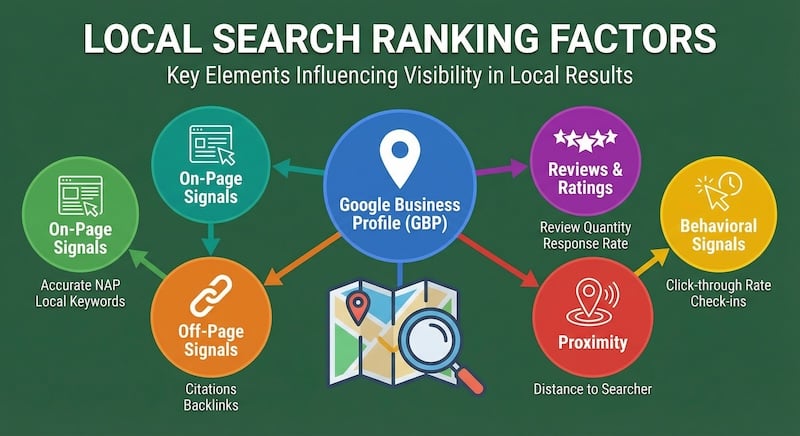
Multi-location SEO generates massive amounts of data, and it’s easy to get lost in metrics that don’t actually drive business results. After years of optimization and testing, we’ve identified the KPIs that best predict success.
Location-Specific Rankings
Track your rankings for key search terms in each location’s local market. This means not just “plumber near me” but “emergency plumber in Chicago,” “water heater installation Dallas,” and other geo-modified keywords specific to each location.
Use rank tracking tools that can check rankings from specific GPS coordinates, simulating searches from different parts of each location’s service area. Rankings can vary significantly even within a single city based on where the searcher is located.
Local Pack Visibility
Appearing in Google’s Local Pack (the map with three business listings that appears for local searches) drives enormous click-through rates. Monitor what percentage of your locations appear in the Local Pack for their primary keywords.
We’ve found that businesses appearing in the Local Pack receive 33% more website visits and 44% more phone calls than those appearing only in organic results below the map.
Profile Engagement Metrics
Google Business Profile Insights provide valuable data on how customers find and interact with your profiles. Track by location:
- Total views (how many times your profile appeared in search or maps)
- Search queries (what terms led people to find your profile)
- Actions taken (website clicks, calls, direction requests)
- Photo views (indicating customer interest)
These metrics help identify which locations are successfully converting visibility into customer actions and which need optimization.
Conversion Tracking by Location
Ultimately, local SEO success means driving qualified leads to each location. Implement conversion tracking that attributes website form submissions, phone calls, and direction requests to specific locations.
Our Google Analytics optimization services help clients set up location-specific conversion tracking, allowing them to calculate the actual ROI of their multi-location SEO efforts.
Common Pitfalls and How to Avoid Them
In our work with multi-location businesses, we’ve seen the same mistakes repeated over and over. Here are the most common pitfalls and how to avoid them:
Duplicate Content Penalties
Creating dozens of near-identical location pages is tempting when you’re managing multiple locations, but it’s also a guaranteed way to tank your rankings. Google’s algorithms excel at detecting thin, duplicative content.
The solution isn’t to avoid templates—it’s to use templates as frameworks while ensuring substantial unique content for each location. A good rule: if you could swap location names and the page would make sense for a different location, you don’t have enough unique content.
Inconsistent Business Information
Data inconsistency is perhaps the most common and most damaging mistake we see. A restaurant chain listing their Chicago location as “123 Main Street” on their website, “123 Main St” on Google, and “123 E Main Street” in directories creates confusion that directly impacts rankings.
Implement strict data standards and audit your citations quarterly to catch and correct inconsistencies before they cause ranking damage.
Neglecting Review Management
Unanswered reviews—especially negative ones—signal to both potential customers and search engines that a business doesn’t care about customer feedback. For multi-location businesses, even a 24-48 hour delay in responding can accumulate into hundreds of unanswered reviews.
Establish clear response protocols and hold location managers accountable for maintaining their review response rates.
Treating All Locations Identically
Not all locations perform equally or face the same competitive landscape. A location in downtown Chicago faces vastly different competition and customer behavior than a suburban location.
Segment your locations by market competitiveness and allocate optimization resources accordingly. Your flagship or most competitive locations may warrant additional investment in local link building or content creation.
The Technology Stack for Multi-Location Success
The right tools make multi-location SEO manageable. Based on our experience managing SEO for businesses with dozens of locations, here are the essential technology components:
Citation Management Platform: Tools like Moz Local or Yext help ensure consistent business information across hundreds of directories and maintain ongoing monitoring for inconsistencies.
Review Aggregation Software: Platforms that pull reviews from all major sites into a single dashboard make it possible to stay on top of customer feedback across multiple locations.
Rank Tracking Tools: Use location-specific rank tracking that can monitor rankings from different geographic coordinates for each of your locations.
Analytics Platform: Google Analytics 4, properly configured with location-specific views and conversion tracking, provides the data needed to measure ROI by location.
Project Management System: Managing optimization tasks across dozens of locations requires robust project management tools to track what needs to be done, where and by whom.
Our team has developed streamlined workflows integrating these tools, ensuring our multi-location clients have visibility into every location’s performance without drowning in data.
Real Results: What Success Looks Like
Theory is valuable, but results matter more. Across our portfolio of multi-location clients in industries ranging from healthcare to retail to professional services, we’ve seen consistent patterns in what drives success:
Businesses that implement comprehensive location page strategies see an average 45% increase in organic traffic to location-specific pages within six months. Those that maintain complete, optimized Google Business Profiles across all locations experience a 60% increase in direction requests and phone calls. And companies that build systematic local link profiles see their locations climb an average of 8-10 positions in local pack rankings over a 12-month period.
Perhaps most importantly, businesses that treat multi-location SEO as an ongoing operational system rather than a one-time project maintain their competitive advantage even as markets become increasingly crowded.
Looking Ahead: Multi-Location SEO in 2026 and Beyond
As search engines become more sophisticated and competition for local visibility intensifies, multi-location businesses face both challenges and opportunities. Several emerging trends will shape multi-location SEO strategy in the coming years:
AI-Powered Search: As search engines increasingly use AI to understand user intent and generate results, businesses with comprehensive, accurate location data and genuine local presence signals will have significant advantages.
Voice Search Optimization: With voice searches continuing to grow, optimizing for natural language queries like “find a plumber near me that’s open now” becomes crucial.
Hyperlocal Targeting: Search results are becoming increasingly personalized based on precise GPS location, making it essential for multi-location businesses to optimize for very specific neighborhood-level searches.
Review Quality Over Quantity: Search engines are getting better at distinguishing genuine, detailed reviews from generic ones. Encouraging customers to leave specific, authentic reviews will become even more important.
Partner with Experts Who Understand Multi-Location Complexity
Managing SEO for multiple locations isn’t just about implementing tactics—it’s about building systems that scale, maintaining data quality across hundreds of touch points, and continuously optimizing performance across diverse markets.
At SEO Design Chicago, we’ve spent over a decade refining our approach to multi-location SEO through work with clients ranging from regional chains with a handful of locations to national brands with hundreds of locations across the country. We understand that each location has unique challenges, competitive landscapes, and customer behaviors.
Our comprehensive approach combines technical SEO expertise, strategic web development, data-driven optimization, and proven systems for managing complexity at scale. Whether you’re opening your third location and want to build a scalable foundation or managing 50+ locations that aren’t performing to their potential, our team has the experience and tools to drive measurable results.
Ready to dominate local search in every market you serve? Contact our team today to discuss how we can develop a customized multi-location SEO strategy for your business. Let’s turn your multiple locations from a complexity challenge into a competitive advantage.

Contact Us today!