






Local SEO Reporting
- 1 Local SEO Reporting
- 1.1 What is Local SEO Reporting?
- 1.2 Starting with a Local SEO Audit
- 1.3 Why Local SEO Reporting Matters
- 1.4 Why Local SEO Reporting Matters
- 1.5 Key Elements of Effective Local SEO Reporting
- 1.5.1 Google Business Profile Interactions Data
- 1.5.2 Number of Local Citations
- 1.5.3 Accuracy of Local Citations
- 1.5.4 Optimization Level of Google Business Profile
- 1.5.5 Optimization Level of Bing Places Profile
- 1.5.6 Ranking Grids for Keywords
- 1.5.7 Map Pack Ranking Relevance
- 1.5.8 Reviews Analysis
- 1.5.9 Products and Services Optimization
- 1.5.10 Geo-Grid/Proximity-Based Ranking Analysis
- 1.5.11 Local Organic Traffic and Conversions
- 1.5.12 Voice Search Performance
- 1.5.13 Google Local Service Ads Performance
- 1.5.14 Ranking for AI and LLMs
- 1.5.15 Competitor Ranking Comparison and Analysis
- 1.5.16 Competitor Optimization Benchmarking
- 1.6 Using Competitor Insights to Optimize Your Strategy
- 1.7 Connecting Data to Real-World Business Results
- 1.8 Key Benefits of Local SEO Reporting
- 1.9 Why Work with SEO Design Chicago
- 1.10 Local SEO Reporting Benefits
Here’s a statistic that should stop every local business owner in their tracks: 46% of all Google searches have local intent, and 80% of US consumers search online for local businesses on a weekly basis. Even more compelling, 76% of people who search for something nearby on their smartphone visit a business within just 24 hours. If your business isn’t showing up in these searches—or worse, if you don’t even know where you rank—you’re leaving money on the table every single day.
This is where local SEO reporting becomes your secret weapon. Local SEO reporting is the systematic process of tracking, measuring, and analyzing your business’s performance in local search results. It encompasses everything from your Google Business Profile interactions to your citation accuracy, review sentiment, and keyword rankings across different geographic areas.
But local SEO reports aren’t just about collecting data; they’re about transforming that data into actionable insights that drive real business results. The businesses that dominate their local markets aren’t guessing at what works; they know. They’re using comprehensive local SEO ranking reports to make data-driven decisions that consistently outperform their competition.
As one of the top local SEO companies in the country, SEO Design Chicago has helped hundreds of businesses across industries, from local SEO services for plumbers and contractors to local SEO for lawyers and healthcare providers, leverage the power of strategic reporting to dominate their local markets. In this comprehensive guide, we’ll show you exactly what elements your local SEO reports need to include, how to use competitor data to your advantage, and why partnering with the best local SEO agency can transform your business.
What is Local SEO Reporting?
Local SEO reporting is a specialized form of SEO reporting that focuses specifically on metrics that impact local search visibility. Unlike general SEO reports that might emphasize domain authority and organic traffic from anywhere in the world, local SEO reports zero in on the factors that determine whether your business appears when someone in your service area searches for your products or services.
A comprehensive local SEO report tracks metrics including Google Business Profile performance, local keyword rankings, citation consistency, review analysis, map pack positions, and increasingly, visibility in AI-powered search results. These reports provide a clear picture of how your business performs vs local competitors and where opportunities exist for improvement.
The key difference between local SEO reports and general SEO reporting lies in the geographic component. Local SEO ranking reports must account for proximity factors—the reality that search results vary significantly based on the searcher’s location. Someone searching from downtown Chicago will see different results than someone in the suburbs, even for the same query. Effective local SEO reporting tools capture these geographic variations to give you a true picture of your local visibility.
Starting with a Local SEO Audit
Before you can effectively track and report your local SEO performance, you need to establish a baseline through a comprehensive local SEO audit. A free local SEO audit or professional local SEO analysis identifies your current strengths, weaknesses, and opportunities across all the factors that influence local search rankings.
A thorough audit examines your Google Business Profile optimization level, citation accuracy across directories, on-site local SEO factors, competitor landscape, and review profile. This baseline assessment reveals exactly where you stand and what needs improvement. Without this foundation, your ongoing local SEO reports lack context—you won’t know if you’re making progress or simply treading water.
The audit also informs your reporting strategy by identifying which metrics matter most for your specific situation. A local SEO specialist or local SEO consultant can help you interpret audit findings and establish the KPIs that will drive your ongoing reporting. For instance, if your audit reveals significant citation inconsistencies, tracking citation accuracy becomes a priority metric. If competitors are dominating the review space, review velocity and sentiment take center stage.
Why Local SEO Reporting Matters
The statistics make an overwhelming case for the importance of local SEO—and by extension, local SEO reporting. Consider these numbers: 99% of people have used the internet to look up information about a local business in the past year, and 32% of American consumers search for local businesses daily. With nearly 97 billion monthly local searches on Google—that’s 37,000 local searches every second—the opportunity is massive.
More importantly, local searches convert at extraordinary rates. 28% of searches with local intent result in a purchase, and 88% of consumers who conduct a local search on their smartphone visit or call a store within 24 hours. For businesses serving local customers—whether you’re offering local SEO for restaurants, local SEO for chiropractors, or local SEO for HVAC companies—these aren’t just website visits. They’re phone calls, store visits, and revenue.
The growth of mobile search has amplified this even further. 30% of all mobile searches relate to location, and “near me” searches have grown by over 900% in the past two years. 82% of US shoppers use “near me” searches on their smartphones while shopping. If you’re not tracking your performance in these high-intent searches through detailed local SEO reports, you’re flying blind.
The landscape is also evolving rapidly with AI and voice search. Google’s AI Overviews doubled their presence in search results from 6.5% in January 2025 to 13.1% by March 2025. Voice searches increasingly drive local discovery, with users asking their devices for recommendations rather than typing queries. This makes comprehensive local SEO reporting more critical than ever. Businesses need to track not just traditional rankings but their visibility across these emerging channels.
Why Local SEO Reporting Matters
The statistics make an overwhelming case for the importance of local SEO—and by extension, local SEO reporting. Consider these numbers: 99% of people have used the internet to look up information about a local business in the past year, and 32% of American consumers search for local businesses daily. With nearly 97 billion monthly local searches on Google—that’s 37,000 local searches every second—the opportunity is massive.
More importantly, local searches convert at extraordinary rates. 28% of searches with local intent result in a purchase, and 88% of consumers who conduct a local search on their smartphone visit or call a store within 24 hours. For businesses serving local customers—whether you’re offering local SEO for restaurants, local SEO for chiropractors, or local SEO for HVAC companies—these aren’t just website visits. They’re phone calls, store visits, and revenue.
The growth of mobile search has amplified this even further. 30% of all mobile searches relate to location, and “near me” searches have grown by over 900% in the past two years. 82% of US shoppers use “near me” searches on their smartphones while shopping. If you’re not tracking your performance in these high-intent searches through detailed local SEO reports, you’re flying blind.
The landscape is also evolving rapidly with AI and voice search. Google’s AI Overviews doubled their presence in search results from 6.5% in January 2025 to 13.1% by March 2025. Voice searches increasingly drive local discovery, with users asking their devices for recommendations rather than typing queries. This makes comprehensive local SEO reporting more critical than ever. Businesses need to track not just traditional rankings but their visibility across these emerging channels.
Key Elements of Effective Local SEO Reporting
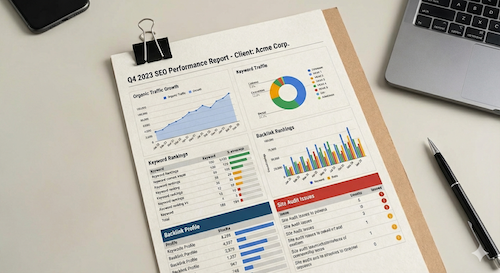
The best SEO reporting tools and SEO reporting platforms capture a comprehensive set of metrics that together paint a complete picture of local search performance. Here are the essential elements every local SEO report should include:
Google Business Profile Interactions Data
Your Google Business Profile is your digital storefront—76% of marketers consider GBP management the most valuable local SEO service. According to research, customers are 2.7 times more likely to trust a business with a complete Business Profile, and verified businesses receive over 21,643 views annually in Google searches.
Your local SEO reports should track all GBP interaction metrics: search impressions (how often your profile appears), actions taken (calls, direction requests, website clicks, messages), and photo views. These metrics directly correlate with real-world customer behavior. A drop in direction requests might indicate ranking issues or increased competition, while growing call volume signals effective optimization.
Number of Local Citations

Local citations—mentions of your business name, address, and phone number across the web—remain a foundational local SEO ranking factor. Citations for local SEO appear on business directories, social platforms, industry-specific sites, and local news outlets. The quantity of quality citations signals to search engines that your business is established and legitimate.
Your local SEO report should track total citation count, new citations acquired, and the quality of citation sources. Not all citations are equal—a mention on your local Chamber of Commerce website or industry association directory carries more weight than a generic business listing site. Local SEO citation building should focus on quality directories relevant to your industry and location.
Accuracy of Local Citations
Citation accuracy—specifically NAP consistency (Name, Address, Phone)—is equally important as quantity. Inconsistent business information across directories confuses both search engines and potential customers. If your phone number is listed differently across various sites, or if old addresses still appear in some directories, it damages both your rankings and your credibility.
Regular citation audits should be part of your local SEO reporting process. Track the percentage of citations with accurate information and prioritize fixing inconsistencies. This is particularly important for businesses that have moved, changed phone numbers, or rebranded. A professional local SEO company can help manage citation cleanup at scale.
Optimization Level of Google Business Profile

Beyond interactions, your local SEO reports should track your GBP optimization score. This includes completeness factors like business description, categories, attributes, products, services, photos, posts, and Q&A. Research shows that businesses posting weekly updates see a 30% increase in customer interactions compared to static listings.
Track specific optimization elements: Do you have a complete business description with relevant keywords? Have you selected all applicable categories? Are you regularly posting updates, offers, and events? Do you have sufficient high-quality photos? Listings with quality photos get significantly more engagement. These factors directly impact your local map pack visibility.
Optimization Level of Bing Places Profile
While Google dominates search, Bing shouldn’t be ignored—it powers search for Microsoft products, Alexa, and other platforms. Your local SEO reporting should include Bing Places optimization tracking. Many businesses neglect Bing entirely, which creates an opportunity to capture traffic that competitors miss.
Track Bing Places completeness, accuracy, and performance metrics. Ensure your Bing listing mirrors your Google Business Profile in terms of categories, descriptions, and photos. This consistency across platforms strengthens your overall local SEO presence.
Ranking Grids for Keywords
Traditional rank tracking isn’t enough for local SEO. Because search results vary by location, you need ranking grids that show how you perform across different geographic points in your service area. These geo-grid visualizations reveal that you might rank first for “plumber” when someone searches from your neighborhood, but not appear at all for searchers five miles away.
The best local SEO reporting tools provide heatmap-style ranking grids that show your position across multiple search locations simultaneously. This granular view helps identify geographic areas where you’re strong and areas requiring more optimization effort—essential insights for businesses offering local SEO for multiple locations in one city.
Map Pack Ranking Relevance
The local map pack—the three business listings that appear with a map in local search results—captures a disproportionate share of clicks. Appearing in this coveted three-pack position dramatically increases visibility and drives significant traffic. 52% of marketers rank Google Local Pack/Local Finder positions as their most important local SEO metric.
Your local SEO reports should track map pack positions for all target keywords and how these positions vary across your service area. Monitor position changes over time and correlate them with optimization activities. When you gain or lose map pack position, understanding why is crucial for ongoing strategy.
Reviews Analysis

Reviews are both a ranking factor and a conversion factor. 83% of consumers use Google to find local business reviews, and 90% of consumers check reviews before visiting a business. Perhaps most striking, 71% of consumers won’t consider using a business with an average rating below three stars. Highly rated businesses outrank those with lower ratings by a median of 11 positions.
Your local SEO reporting should track review volume, velocity (new reviews over time), average rating, and sentiment analysis. Monitor reviews across all platforms: Google, Yelp, Facebook, and industry-specific sites. Also track response rate and response time, as 86% of consumers will forgive negative feedback if a business responds thoughtfully.
Products and Services Optimization
Google Business Profile allows businesses to list products and services directly in their profile. This feature helps searchers quickly understand what you offer and can appear prominently in search results. For service-based businesses like law firms, local SEO or healthcare local SEO, detailed service listings help match with relevant searches.
Track the completeness of your products and services listings, including descriptions, categories, and pricing where applicable. Monitor which products or services generate the most profile interactions. This data informs both your GBP optimization and broader marketing strategy.
Geo-Grid/Proximity-Based Ranking Analysis
Proximity is a major local ranking factor—Google shows different results based on where the searcher is located. Geo-grid analysis maps your rankings across a grid of locations throughout your service area, revealing exactly where you’re visible and where you disappear.
These visual heatmaps are particularly valuable for understanding your true local reach. You might discover that you dominate rankings near your physical location but lose visibility in surrounding neighborhoods. This insight drives targeted optimization efforts and helps set realistic expectations about your geographic competitive landscape.
Local Organic Traffic and Conversions
Rankings matter, but ultimately you need to track the traffic and conversions they generate. Integrating Google Analytics and Google Search Console data with your local SEO reports connects the dots between visibility and business results. Track organic traffic from local keywords, landing page performance for location pages, and conversion actions like form submissions and phone calls.
This connection between rankings and results is what separates useful local SEO reports from vanity metrics. When you can show that improved rankings for “emergency plumber” led to 40% more phone calls, you’re demonstrating real ROI. This is the kind of reporting that keeps local SEO consultants valuable to their clients.
Voice Search Performance
Voice search has become integral to local discovery. Users ask their devices for recommendations in conversational language—”find a plumber open now” or “what’s the best Italian restaurant nearby.” 27% of users visit a local business website after conducting a voice search, and 44.6% of the US is projected to use voice assistants monthly.
Track your visibility for long-tail, conversational keywords that mirror voice search queries. Ensure your GBP has accurate hours, accepts relevant questions in Q&A, and includes the information voice searchers commonly request. Voice search optimization is increasingly important for local SEO for restaurants, local SEO services for accountants, and any business where immediate need drives searches.
Google Local Service Ads Performance
For eligible businesses, Google Local Service Ads provide prominent placement above both organic results and traditional ads. These pay-per-lead ads appear for service-based searches and include Google Guaranteed or Google Screened badges that build trust. Local ad spend is projected to grow 12% annually through 2028, making this channel increasingly important.
Your local SEO reports should track LSA performance, including leads generated, cost per lead, booking rate, and ROI compared to other channels. LSAs complement organic local SEO efforts—combining both creates comprehensive local visibility. For industries like plumbing local SEO, local SEO for contractors, or local SEO for roofing companies, LSAs often deliver excellent ROI.
Ranking for AI and LLMs
The newest frontier in local SEO reporting is tracking visibility in AI-powered search tools. ChatGPT, Google AI Overviews, Perplexity, and other AI assistants increasingly answer local queries. 92% of local SEO professionals have experimented with ChatGPT, and 57% of agency leaders cite AI’s impact on organic search as their top concern for 2025.
AI systems pull information differently from traditional search engines. They favor structured data, consistent citations, authoritative content, and strong review profiles. Monitor whether your business appears in AI-generated recommendations and how it’s described. Ensure your schema markup is comprehensive so AI systems can accurately understand and cite your business information. Traditional SEO metrics alone are no longer enough—visibility in AI responses is becoming critical for local business success.
Competitor Ranking Comparison and Analysis
You don’t exist in a vacuum—local SEO is inherently competitive. As competition for local pack positions intensifies, your local SEO reports must include comprehensive competitor analysis. Track side-by-side keyword ranking comparisons showing your position versus top competitors for every target keyword.
Monitor competitor movement in the local pack. When a competitor gains position, understand why—did they get new reviews, add content, build citations? Identify keywords where competitors rank but you don’t, revealing gaps in your strategy. Benchmark your positions against the top three to five local competitors to maintain perspective on your progress.
Competitor Optimization Benchmarking
Beyond rankings, compare optimization levels across all local SEO factors. Analyze competitor GBP profiles—are they more complete than yours? How many photos do they have? How often do they post? Assess their review profiles—total reviews, average rating, review velocity, and response rate.
Evaluate competitor citation profiles to identify directories where they’re listed that you’re missing. Examine their content—do they have location pages, service pages, or blog content you lack? This comprehensive competitive intelligence reveals exactly what it takes to outperform them and identifies the gaps and opportunities you can exploit.
Using Competitor Insights to Optimize Your Strategy

Data without action is just numbers. The power of competitive analysis comes from translating insights into strategic advantages. Here’s how to use competitor data from your local SEO reports to consistently outperform the competition:
Prioritize keywords where competitors are weak. If your reports show competitors ranking poorly for certain valuable keywords, these represent low-hanging fruit where you can gain ground quickly with focused effort. Improve your GBP completeness to exceed competitor profiles. If their profiles are 70% complete and yours is 95% complete, you have a structural advantage that compounds over time.
Build citations on directories where competitors are missing. Use citation analysis to identify quality directories where competitors haven’t established a presence—these represent opportunities to build relevance they lack. Develop review generation strategies designed to surpass competitors. If the top competitor has 150 reviews and you have 75, create systematic approaches to close that gap through excellent service and proactive review requests.
Create content that fills gaps competitors haven’t addressed. If no competitor has comprehensive location-specific content, service pages, or FAQ content addressing common customer questions, creating this content positions you as the authority. Businesses that actively track and optimize against competitors consistently outperform those that focus only on their own metrics.
Connecting Data to Real-World Business Results
Local business owners—whether they’re running a restaurant, law firm, medical practice, or contracting company—don’t think like marketers. They think about phone calls, appointments, customers walking through the door, and revenue. The most effective local SEO reports translate digital metrics into these real-world outcomes.
For brick and mortar businesses, the connection between online visibility and offline results isn’t always obvious. Your reports need to draw these connections explicitly. Show how improved map pack rankings correlate with increased direction requests. Demonstrate the relationship between review improvements and phone call volume. Connect citation cleanup to GBP interaction growth.
Making reports meaningful for non-technical business owners requires focusing on outcomes rather than activities. Instead of reporting “we built 50 citations this month,” report “we improved your business visibility across 50 local directories, which contributed to a 15% increase in profile views.” Instead of “your map pack ranking improved,” say “you’re now appearing in the top three results for emergency plumber searches, which drove 23 additional calls this month.”
The data strongly support investing in professional local SEO reporting. Studies show that local SEO campaigns that track and optimize based on comprehensive reporting see returns exceeding 500% over three years. Meanwhile, nearly 30% of businesses have no plans to invest in improving local search rankings—representing a significant opportunity for those who do commit to data-driven local SEO optimization services.
Key Benefits of Local SEO Reporting
Comprehensive local SEO reporting delivers benefits that compound over time. First and foremost, it enables ROI tracking that justifies your investment. When you can demonstrate that local SEO spending generated measurable increases in calls, visits, and revenue, you make better budget decisions.
Regular reporting identifies opportunities for improvement before they become problems. Declining review velocity, growing citation inconsistencies, or slipping keyword rankings all signal issues that can be addressed proactively. Without reporting, these problems go unnoticed until they significantly impact visibility.
Understanding your local competition through reporting reveals strategic opportunities. When you know exactly where competitors outperform you and where they’re vulnerable, you can allocate resources efficiently. Data-driven decisions replace guesswork, and your local SEO efforts become increasingly effective over time.
Perhaps most importantly, comprehensive reporting helps you adapt to AI-powered search and voice queries. The search landscape is evolving rapidly—businesses that track their visibility across traditional search, AI assistants, and voice platforms will thrive while others fall behind. Staying ahead of LLM-driven discovery requires the kind of forward-looking reporting that tracks these emerging channels alongside traditional metrics.
Why Work with SEO Design Chicago
SEO Design Chicago has earned recognition as one of the top local SEO companies in the nation by delivering measurable results for businesses across every industry. As a leading local SEO agency and local SEO marketing company, we’ve helped hundreds of clients—from local SEO for therapists to moving company local SEO services—dominate their local markets through strategic, data-driven approaches.
Our local SEO experts bring decades of combined experience and a track record of success. We understand that local SEO best practices require adapting to each industry and market. What works for local SEO for pest control differs from local SEO for churches or b2b local SEO. Our local SEO specialists develop customized strategies that address your specific competitive landscape and business goals.
Our comprehensive reporting approach covers every element discussed in this guide—from GBP optimization and citation building to advanced competitor analysis, AI visibility tracking, and Google Local Service Ads management. We provide expert local SEO audits to establish your baseline and deliver ongoing local SEO reports that translate data into actionable insights.
We pride ourselves on full-service local SEO capabilities. Beyond reporting, we execute all aspects of local SEO optimization services—citation building, review management, content creation, link building, GBP management, and more. Our clients benefit from having a single local SEO marketing agency that handles strategy, execution, and reporting cohesively.
What truly sets us apart is our expertise in translating data into actionable business insights. We don’t just deliver reports—we explain what the data means for your business and provide clear recommendations for improvement. Our forward-thinking approach to AI and LLM optimization ensures our clients stay ahead of the curve as search continues to evolve.
Whether you’re looking for local SEO services near me, exploring local SEO packages, or trying to understand local SEO cost, we offer solutions for businesses of all sizes. Our local SEO companies near me searches consistently show SEO Design Chicago because we practice what we preach—we rank for the keywords that matter.
Local SEO Reporting Benefits
Local SEO reporting isn’t optional—it’s the foundation of effective local search strategy. In a landscape where 46% of searches have local intent and 88% of consumers act within 24 hours of a local search, businesses that track, measure, and optimize their local presence will capture market share. Those that don’t will watch opportunities go to competitors.
The elements we’ve covered—from GBP interactions and citations to competitor analysis and AI visibility—represent the complete picture of local SEO performance. Understanding these metrics, how they interact, and how to optimize against them separates businesses that dominate local search from those that struggle for visibility.
Remember: local SEO campaigns that implement comprehensive reporting see returns exceeding 500% over three years. That’s not a typo—strategic, data-driven local SEO delivers transformative ROI for businesses willing to invest in doing it right.
Ready to crush your local competition? Contact SEO Design Chicago today for a free local SEO audit and discover how our local SEO reporting solutions and optimization services can transform your local visibility. As one of the best local SEO companies in the industry, we have the expertise, tools, and track record to help your business dominate local search.

Contact Us today!